First-Time Snowmobiler FAQ: Everything You Need to Know Before You Ride

Trying snowmobiling for the first time comes with a lot of questions. Here are the ones we hear most often from first-time riders, answered plainly so you know exactly what to expect before your trip.

Do I need experience to go snowmobiling?

No. Our Guided Tours and Self-Guided Rentals are designed for riders of all experience levels, including complete beginners. We will cover machine basics before you head out, if you are on a Guided Tour your guide is right there and available for questions. If you are on a Self-Guided Rental and run into any issues you can call us directly on our help line with questions or to request assistance.

What’s the minimum age to snowmobile?

Tours and rentals have specific driver age and legal guardian participation requirements, and these are enforced without exceptions or refunds for guests who don’t meet them. The minimum age to be a passenger is 4 years old and we do not make any exceptions to this rule. For driver age requirements, please review our driver age requirements.

What should I wear snowmobiling?

Dress in warm layers with waterproof or weatherproof outerwear, and don’t skip waterproof gloves/mittens, snow goggles or a face mask as these are required! Because trail routes can run to higher elevation, come prepared for colder, windier conditions than you might expect. Lower elevation alternate routes are used when weather prevents higher-elevation riding, so conditions can vary trip to trip. For all tours and rentals, we will include your DOT helmet (no ski helmets allowed).

Is snowmobiling scary or dangerous for beginners?

Guided tours are planned with beginners in mind — your guide sets the pace, explains machine controls, and adjusts the route based on group’s comfort level and weather. Most first-timers find the biggest adjustment is simply getting used to the machine and handling in the first few minutes, after which it becomes intuitive.

Guided tour or self-guided rental — which should a first-timer choose?

Both our Guided Tours and Self-Guided rentals are good for anyone without prior snowmobiling experience. On a Guided Tour your guide will start with a machine orientation and set the pace and course for your trip, so you don’t need to worry about timing or navigation. For the Self-Guided rentals, you will be provided with a machine orientation and description of trail routes and options as well as a map of the area and our emergency phone number in case you have questions or need assistance while on trail. You set the pace on a self-guided rental which means you can make as many stops as you would like and we’ll let you know what time to return your machines.

How long are snowmobile tours?

Guided tours are available in 1, 2, and 3-hour options, so first-timers can start with a shorter tour and work up to a longer one on a future trip. Our Self-Guided rentals are available in 2, 4, 6 & 8 hour options to fit your level of adventure.

What happens if the weather is bad?

Our trips operate in all weather conditions, snow or shine. It is best to check the weather and be prepared for all winter weather as conditions can change quickly here in the mountains. If visibility is restricted on higher elevation trails due to heavy snow or fog, lower elevation alternate routes are available to keep the adventure going.

Where can first-timers book a guided tour?

Guided tours depart from the Winter Park/Fraser area (Continental Divide and Trailblazer Tours). Self-guided rentals are available in Winter Park and Grand Lake. To reserve your guided tour or self-guided rental, book your trip online.
Age Requirements for Snowmobile & Side-by-Side Tours

One of the most common questions we get is "how old does my kid need to be?" — and the honest answer is: it depends on which tour you’re booking. Age rules are different for guided tours, self-guided rentals, our family Kids Course, and side-by-side (UTV) tours, so it’s easy to get confused if you’re comparing options.

Here’s the exact breakdown, so you know exactly who can drive and who can ride before you book. No one may drive if they have had a DUI or similar infraction in the past three years.

Quick Answer

Activity Driver Age (without a guardian) Driver Age (with a guardian present) Minimum Passenger Age
Guided Snowmobile Tour (incl. Trailblazers 1.5-Hour Family Tour) 18, with valid driver’s license 15–17, guardian present, license/permit photocopied at check-in, no passenger allowed 4
Kids Course add-on (30 min of the Trailblazers 1.5hr Family Tour only) N/A — built for kid drivers Ages 4–15 drive with a guardian present, in the Kids Course area only N/A (kids drive; guardians supervise, they don’t ride along)
Self-Guided Snowmobile Rental 21, with valid driver’s license 16–20, guardian present, license photocopied at check-in; must be 18+ to carry a passenger 4
Off-Road Side-by-Side (UTV) Tour 18, with valid driver’s license Not offered for minors 4

Guided Snowmobile Tours

Self-Guided Snowmobile Rentals

Self-guided rentals carry a higher age threshold than guided tours, since there’s no guide riding along:

See self-guided rental details and availability

Trailblazers 1.5-Hour Family Tour ("Kids Course")

This tour is the standard 1-hour Trailblazers guided tour with an additional 30 minutes for the Kids Course, for a total of 1.5 hours. Standard Guided Snowmobile Tour age rules apply — adults and older teens drive normally (see above). The Kids Course is designed specifically for kids to drive their own machine during the Family Tour in a supervised area.

Kids Course add-on details:

Don’t book this tour if: you don’t have kids, or your kids don’t want to drive. It’s built around kid drivers.

Off-Road Side-by-Side (UTV) Tours

See side-by-side tour details

Frequently Asked Questions

How old do you have to be to drive a snowmobile at Grand Adventures?

On a guided tour, 18 with a valid license to drive without a guardian, or 15–17 with a guardian present (no passenger allowed). On a self-guided rental, you must be 21 to drive without a guardian, or 16–20 with a guardian present.

Can a teenager drive a snowmobile without an adult?

No. Anyone under 18 (guided tours) or under 21 (self-guided rentals) must have their legal guardian present to drive.

What’s the youngest age to ride as a passenger on a snowmobile?

4 years old, on both guided tours and self-guided rentals.

Can my child drive their own snowmobile?

Yes, on the Trailblazers 1.5-Hour Family Tour ("Kids Course"), kids ages 4–15 can drive their own machine in a dedicated Kids Course area, with a guardian present and staff-assigned machine.

How old do you have to be to drive a side-by-side (UTV)?

18, with a valid driver’s license.

What’s the minimum age to ride in a side-by-side as a passenger?

4 years old, same as snowmobile tours, and kids ages 4–9 must be in a booster seat.

Why are self-guided rental age requirements higher than guided tours?

Self-guided rentals don’t have a guide riding along, so the minimum driver age is higher (21 vs. 18) to reflect the added responsibility.

Do you accept international driver’s licenses?

Yes, a valid international driver’s license is accepted to meet the driver’s license requirement on any tour or rental.

Can I drive if I have a DUI or similar infraction on my record?

No. Drivers with a DUI or similar infraction within the past three years are not permitted to drive on any Grand Adventures tour or rental.

Is a booster seat required for kids on a side-by-side tour?

Yes. Passengers ages 4–9 are required to be in a booster seat on side-by-side tours. This requirement is specific to side-by-side tours and does not apply to snowmobile passengers.

See all Grand Adventures FAQs or book your trip online.

Incident Coverage & Repair Fund: What’s Included With Every Tour

Every snowmobile and side-by-side rental with Grand Adventures — guided or self-guided — automatically includes two things: Incident Coverage and a Repair Fund. You’ll see this as a line item during checkout, and it’s one of the most common things guests ask us to explain. Here’s exactly what it is, what it covers, and what you’re on the hook for if something goes wrong.

Quick Answer

Activity Damage Deposit at Check-In (Credit/Debit Card) Your Maximum Out-of-Pocket (per machine rented)
Snowmobile Guided Tour Card imprint (no cash or checks) $1,500 (parts & labor)
Snowmobile Self-Guided Rental Card imprint + $500 pre-authorization hold per machine $3,000 (parts & labor)
Side-by-Side Tour Card imprint (no cash or checks) $3,000 (parts & labor)

The Repair Fund covers everything above your maximum out-of-pocket amount. The card imprint/pre-authorization is a deposit — you’re only billed up to the actual cost of damage, capped at your activity’s maximum. Deposits are pre-authorizations and will show as a pending charge on your account, so funds must be available in your account.

What Is Incident Coverage?

When you rent with Grand Adventures, you’re added as an additional insured on Grand Adventures’ commercial automobile policy for the duration of your rental. That policy generally provides auto liability coverage — meaning it may pay for bodily injury or property damage caused by an accident during your rental — along with Blanket Accident Coverage.

This coverage is subject to the actual terms, conditions, exclusions, and limits of liability in the policy itself. For specific coverage questions, you can contact our insurance provider, vQuip Insurance Agency, directly at 704-496-9002.

What Is the Repair Fund?

The Repair Fund is separate from Incident Coverage — it’s specifically designed to cap your out-of-pocket cost if your rented machine is physically damaged during a guided tour or self-guided rental. It applies to all snowmobiles and side-by-sides you rent, guided or self-guided.

Here’s how it works:

  1. At check-in, you’ll provide a credit or debit card for an imprint (all rentals) and, for self-guided rentals, a $500 per-machine pre-authorization hold. The cardholder must be present, and we don’t accept cash or checks for damage deposits.
  2. If damage occurs, your maximum out-of-pocket expense per machine is capped at:
    • Snowmobile guided tours: $1,500 (parts & labor)
    • Snowmobile self-guided rentals: $3,000 (parts & labor)
    • Side-by-side tours: $3,000 (parts & labor)
  3. Anything above that cap — the rest of the parts and labor cost — is covered by the Repair Fund, not billed to you.
  4. Late fees (self-guided rentals) and retrieval fees, where applicable, are not covered by the Repair Fund.

Do I Have to Purchase This Coverage?

Yes — Incident Coverage and Repair Fund protection is required for every tour and rental, and will show as a mandatory add-on cost during checkout. It’s not an optional upgrade.

See guided snowmobile tour details | See self-guided rental details | See side-by-side tour details

Frequently Asked Questions

What is Incident Coverage?

Incident Coverage adds you as an additional insured on Grand Adventures’ commercial automobile policy for your rental period. It generally provides auto liability coverage for bodily injury or property damage caused by an accident, along with Blanket Accident Coverage, subject to the policy’s actual terms, conditions, exclusions, and limits.

What is the Repair Fund?

The Repair Fund caps your maximum out-of-pocket cost if your rented snowmobile or side-by-side is physically damaged during a guided tour or self-guided rental. Costs above your activity’s cap are covered by the fund rather than being billed to you.

Do I have to pay for the Incident Coverage and the Repair Fund?

Yes. Both are included with every tour and rental and appear as a line item during checkout — they’re not optional add-ons you can opt out of.

What’s my maximum out-of-pocket if my machine gets damaged?

It depends on your activity: $1,500 for snowmobile guided tours, and $3,000 for both snowmobile self-guided rentals and side-by-side tours (parts and labor). Deductible amounts are per machine.

What is the damage deposit, and how much is it?

At check-in, we take a credit or debit card imprint as your damage deposit on all rentals. For self-guided rentals, we also place a $500 per-machine pre-authorization hold. This is a deposit, not a charge — you’re only billed up to the actual cost of damage (parts + labor), capped at your maximum out-of-pocket amount.

Can I pay my damage deposit with cash or a check?

No. We only accept a credit or debit card imprint for damage deposits, and the cardholder must be present at check-in and must be 21 years of age or older.

Who do I contact with questions about the insurance policy itself?

For specific questions about the auto liability coverage terms, conditions, exclusions, or limits, contact vQuip Insurance Agency directly at 704-496-9002.

Do I get refunded if I don’t have any damage?

No, you are buying coverage and refunds are not provided after the trip.

Will the damage deposit show up as a charge on my account?

The card imprint and, for self-guided rentals, the $500 per-machine pre-authorization hold will show as a pending charge on your account. You’ll need sufficient available funds or credit to cover the hold amount.

Does the Repair Fund cover late fees or retrieval fees?

No. Late fees (self-guided rentals) and retrieval fees, where applicable, are not covered by the Repair Fund.

See all Grand Adventures FAQs or book your trip online.

Yes, You Can Drive From Denver to Snowmobile in the Same Day

Looking for a winter adventure that doesn’t require a whole weekend away? Winter Park/Fraser and Grand Lake are close enough to Denver to make snowmobiling a realistic day trip — no overnight stay required. Here’s what to know before you go.

Quick Answer

Question Answer
Drive time from Denver About 90 minutes to Winter Park/Fraser; add roughly another hour to reach Grand Lake. Ski- and weather-driven traffic is common and can more than double drive time on holidays, weekends, and in winter weather.
Best tour length for a day trip A 1–2 hour guided tour fits comfortably alongside the drive.
Experience required None — guided tours and self-guided rentals are built for first-timers.
Rideshare back to Denver Not available. There are currently no Uber or Lyft drivers serving return trips from the mountains to Denver — bring your own vehicle and be prepared for snowy/icy roads (traction laws apply in winter).
Taking the train Possible, but timing is tight and the train doesn’t drop you at our meeting locations — see the FAQ below before you book.

How far is Winter Park from Denver?

Grand Adventures is located about 90 minutes from Denver, near Winter Park Resort in Grand County. That drive time makes it possible to leave Denver in the morning, spend a few hours on the trail, and be back the same evening. Keep in mind, ski- and weather-driven traffic is very common on the drive from Denver to Winter Park and can more than double your drive time during holidays, weekends, and winter weather conditions.

Planning your day

A typical day-trip itinerary looks something like this:

  1. Leave Denver early morning to account for mountain drive time and any winter road conditions.
  2. Arrive at your chosen location — Grand Adventures operates out of four locations across Winter Park, Fraser, and Grand Lake, so make sure you know where you booked and for what activity (guided or self-guided).
  3. Ride — guided tours run 1, 2, or 3 hours on trail; self-guided rentals can run up to a full day if you want to make the most of the trip. Your time with us is generally 1–2 hours longer than your time on trail, with extra time for check-in/check-out, getting ready for the trail, and a quick shuttle ride for our self-guided Winter Park location and early-season guided tours.
  4. Grab a late lunch or early dinner in Winter Park or Fraser before heading back to Denver.

Choosing between locations

If you’re short on time, a shorter guided tour (1–2 hours) fits neatly into a single day alongside the drive. If you want to make the whole day about riding, a longer self-guided rental gives you more trail time.

See guided tour details | See self-guided rental details

What to bring for a day trip

Because you’re driving up from lower elevation, pack for a bigger temperature swing than you’d expect in Denver:

Frequently Asked Questions

Can you snowmobile as a day trip from Denver?

Yes. Winter Park is roughly 90 minutes from Denver (add another hour to get to Grand Lake), making a same-day snowmobiling trip a realistic option without booking overnight lodging.

What’s the best snowmobile tour length for a day trip from Denver?

A 1 to 2-hour guided tour fits comfortably into a day trip alongside drive time. If you want more time on the trail, a self-guided rental with a longer duration is a better fit.

Do I need snowmobiling experience for a day trip?

No. Guided tours and self-guided rentals are built for first-timers and don’t require prior experience.

What should I wear for a one-day snowmobiling trip?

Dress in warm layers, gloves, goggles, a facemask or scarf, and weatherproof outerwear. Be prepared for lower-elevation alternate routes if weather affects trail access higher up.

Can I take an Uber back to Denver?

No. There are currently no Uber or Lyft drivers who provide return trips from the mountains to Denver. Having your own vehicle — like a rental car with adequate snow tires and traction — is the best option for day trips to and from Denver.

Can I take the train from Denver for a day trip?

Yes, but there are a few things to know first. Our meeting locations are not where the ski train drops you off, so you’ll need to arrange the correct shuttle bus to your snowmobile meeting location. The train often runs late, and if you’re late for your scheduled tour or rental, there’s a good chance you could miss your non-refundable trip — reservations are not refunded or rebooked due to late train arrival. A few timeslots can work when combining the train with a connecting shuttle, but you’ll need to plan ahead for your snowmobile tour and total time with us. If you’re taking the train, the most direct option is getting off at the Winter Park Resort train stop and booking a Guided Continental Divide Tour out of our Jane’s Edge office.

What is the closest location to Denver?

Our Continental Divide Tours, Self-Guided Rentals, and Trailblazer Tours are all within about 10 minutes of each other, but they operate out of 3 separate offices. Please check your confirmation email for the correct meeting location.

Do I need to book in advance for a day trip?

Yes, advance reservations are highly recommended. Tours and rentals can sell out, especially on weekends, holidays, and during peak winter season, so booking ahead helps make sure your preferred time and location are available.

See all Grand Adventures FAQs or book your trip online.

Why Winter Park Has Some of Colorado’s Best Snowmobiling

Colorado has no shortage of snowmobiling destinations, but Winter Park stands out for a simple reason: the mountains here are built for it. High elevation, huge snowfall totals, and a wide mix of terrain come together to create conditions that are hard to match anywhere else in the state.

Elevation That Delivers Real Alpine Terrain

The Town of Winter Park sits at roughly 9,000 feet, with surrounding peaks and trails climbing well above 11,000 and 12,000 feet. That elevation matters for snowmobiling in a couple of ways: it keeps snow cold, dry, and consistent through the season instead of turning heavy or slushy, and it opens up true above-treeline riding, with sweeping views across the Continental Divide that lower-elevation trail systems simply can’t offer.

Some of the Deepest Snow in the State

The Winter Park area regularly sees more than 300 inches of snowfall a year, among the highest totals of any destination in Colorado. That volume of snow means a longer, more reliable season and consistently deep, well-covered trails — important for both the smoothness of the ride and the powder conditions riders come here chasing. Storms roll through often enough that fresh snow is a regular occurrence rather than a rare bonus.

Terrain Variety in One Trip

What really sets Winter Park apart is how much variety sits within reach of a single ride. In one outing, riders can move through dense pine forest trails, open subalpine meadows, and wide-open above-treeline terrain near the Continental Divide — a mix that few other Colorado destinations pack into one trail system. That variety keeps rides interesting for first-timers and experienced riders alike, and it’s part of why the area near Rollins Pass and the surrounding national forest is such a well-regarded riding destination.

A Season That Lasts

Between the elevation and the snowfall totals, Winter Park’s riding season tends to run longer than lower-elevation areas — often from late November well into spring. That gives visitors more flexibility to plan a trip without worrying as much about marginal early- or late-season conditions.

Experience It With Grand Adventures

All of this terrain is best experienced with someone who knows it well. Grand Adventures runs guided snowmobile tours out of Winter Park and Fraser, taking riders through the forest trails, meadows, and high alpine terrain that make this area one of Colorado’s best snowmobiling destinations. No experience is necessary — our guides handle the route and pacing, so you can focus on the ride. Grand Adventures also offers Self-Guided rentals out of Winter Park and Grand Lake for those who want to experience the trails on their own.

See all Grand Adventures snowmobiling trip options

Quick Answers

Why is Winter Park good for snowmobiling?

Winter Park combines high elevation, heavy annual snowfall, and varied terrain, from forest trails to above-treeline alpine riding, giving it some of the most consistent and diverse snowmobiling conditions in Colorado.

How much snow does Winter Park get?

The Winter Park area sees over 300 inches of snowfall in an average year, one of the higher totals of any destination in the state.

What is the snowmobiling season like in Winter Park?

Thanks to the elevation and snowfall totals, the riding season typically runs from late November into spring, longer than many lower-elevation Colorado destinations.

How do I book a trip with Grand Adventures?

Visit the Grand Adventures snowmobiling page to learn more, or book your trip online to check availability and reserve your spot.

What to Wear Snowmobiling in Colorado: The Complete Gear Guide

For snowmobiling in Colorado, wear insulated, moisture-wicking base layers, a warm mid-layer, and a waterproof/windproof outer layer, plus waterproof gloves and eye protection. Grand Adventures includes a free DOT-approved helmet with every guided tour and self-guided rental. If you don’t own snow gear, we also offer snowsuit and snow boot rentals, plus goggles, gloves, and face coverings for sale on-site. Whether you’re booking a guided tour along the Continental Divide or heading out on a self-guided rental near Grand Lake or Winter Park, the right gear is the difference between a trip you’ll want to repeat and one where all you can think about is your frozen toes. Here’s exactly what to wear and why.

Why Layering Matters More Than Any Single Piece of Gear

Colorado’s high country can swing 20+ degrees between the trailhead and the top of the Continental Divide, especially once you’re above 11,000 feet. The best defense isn’t one heavy coat — it’s a three-layer system that traps heat, moves sweat away from your skin, and blocks wind and snow.

1. Base Layer (Next to Skin)

Your base layer needs to be warm and moisture-wicking — its job is to trap heat while pulling sweat away from your body, not just keep you warm. Cotton is the enemy here — once it gets damp from sweat, it stays wet and pulls heat away from your body.

– Look for merino wool, polyester, fleece, or other synthetic thermal fabrics
– Top and bottom (long sleeve top, long underwear bottoms)
– Moisture-wicking socks — wool or synthetic blends, never cotton

2. Mid Layer (Insulation)

This is your warmth layer — think fleece or a light insulated jacket. On warmer days you may only need a light fleece; on colder days, add a heavier layer or a puffy vest.

– Fleece pullover or jacket
– Insulated vest (great for regulating core temperature without overheating your arms)

3. Outer Layer (Required, Warm and Waterproof)

This is the layer that actually stops wind, snow, and moisture from reaching everything underneath — it needs to be both warm and fully waterproof, not just water-resistant. A ski or snowboard jacket and snow pants work well if you don’t own snowmobile-specific gear, as long as they meet both of those requirements.

– Waterproof, windproof jacket
– Waterproof snow pants or bibs (bibs help keep snow out and stay put better while you’re riding)

What Grand Adventures Provides vs. What to Bring

One of the most common questions we get from first-time riders is whether they need to buy a bunch of specialized gear before their trip. You don’t.

Included free with every trip:
– A DOT-approved helmet

If you’d rather wear your own, personal helmets are welcome as long as they’re DOT-approved. Ski and snowboard helmets are not permitted on our tours or rentals since they aren’t DOT-rated for motorized use.

Don’t own snow gear? We’ve got you covered on-site:
– Rent: Snowsuits and snow boots are available to rent if you don’t have your own waterproof outerwear or winter boots
– Buy: Goggles, gloves, and face coverings (balaclavas/buffs) are available for purchase on-site if you forget yours or don’t own a pair

You should bring:
– Warm layers
– Waterproof insulated layers, unless you’re renting a snowsuit
– Waterproof gloves — snowmobile-specific or ski gloves both work, just make sure they’re insulated and waterproof
– Goggles — required for eye protection on all tours and rentals; sunglasses are not permitted
– A neck gaiter, scarf, or face mask for wind protection on colder days
– Waterproof winter boots, unless you’re renting a pair from us
– Sunscreen — the sun reflecting off snow at elevation is stronger than most people expect

This applies whether you’re joining one of our guided tours out of Winter Park or Fraser, or heading out on a self-guided rental from Winter Park or Grand Lake. And if you forget or don’t own something, don’t stress — goggles, gloves, and face coverings are available to purchase, and snowsuits and boots are available to rent right at our locations.

A Few Gear Mistakes to Avoid

– Cotton anything. Jeans, cotton hoodies, and cotton socks soak up sweat and snow and stay cold and wet all day.
– Gloves without waterproofing. Gloves are required to be waterproof — your hands are gripping cold handlebars for hours, and this is the single most common spot people get cold.
– Skipping eye protection. Sunglasses aren’t allowed — goggles are required, and skipping them isn’t an option. Between wind, cold, and snow spray, riding without goggles is genuinely unsafe.
– Underestimating the elevation. Grand County trails climb toward the Continental Divide near 12,000 feet, where it’s noticeably colder and windier than the trailhead. Dress for the top of the mountain, not the parking lot.

Required Packing Checklist

Frequently Asked Questions

Q: Do I need to buy a snowmobile suit before my trip?
A: No. A ski or snowboard jacket and snow pants work fine as long as they’re waterproof and windproof. If you don’t own winter outerwear at all, Grand Adventures offers snowsuit and snow boot rentals on-site, so there’s no need to buy anything special before your trip.

Q: What if I forget my gloves or goggles?
A: No problem — goggles, gloves, and face coverings like balaclavas and buffs are all available to purchase at our locations.

Q: Can I wear sunglasses instead of goggles?
A: No. Goggles are required for all guided tours and self-guided rentals — sunglasses aren’t permitted. Goggles seal against wind, cold, and blowing snow in a way sunglasses can’t. If you don’t have a pair, goggles are available to purchase at our locations.

Q: Does Grand Adventures provide helmets?
A: Yes, a DOT-approved helmet is included free with every guided tour and self-guided rental. Guided tours provide open-face helmets, while self-guided rentals let you choose between an open-face or moto-style helmet. You’re also welcome to bring your own helmet as long as it’s DOT-approved.

Q: Can I wear my ski or snowboard helmet while snowmobiling?
A: No. Ski and snowboard helmets aren’t DOT-approved for motorized use and aren’t permitted on our tours or rentals. We provide a DOT-approved helmet free of charge, so this isn’t something you need to plan around.

Q: What if I don’t own snow gear at all?
A: Layer with what you have — synthetic athletic wear as a base layer, a warm fleece or jacket as a mid-layer, and the warmest waterproof outer shell you can find. Avoid cotton at all costs.

Q: What temperature should I expect in Winter Park and Grand Lake?
A: Trail temperatures typically range from the teens to the 30s°F depending on the month and time of day, with wind chill making it feel colder at speed and higher elevation.

Ready to hit the trails? Book a guided tour or self-guided rental at one of our Winter Park, Fraser, or Grand Lake locations.


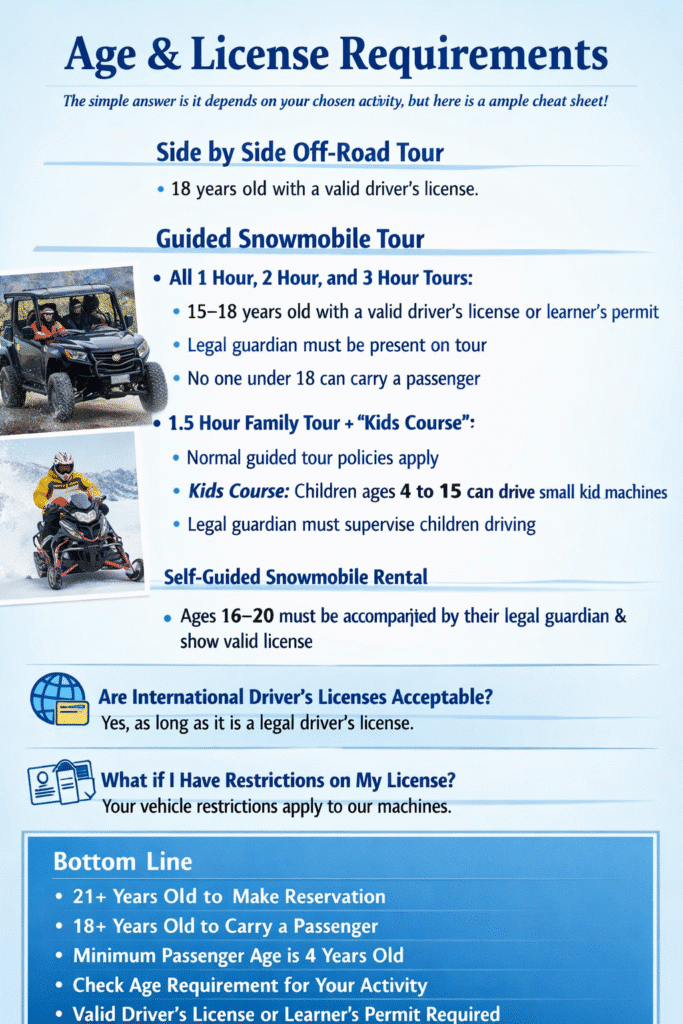
How old do you have to be to drive a snowmobile or side by side with Grand Adventures?

The simple answer is it depends on your chosen activity, but here is a simple cheat sheet!

Side by Side Off-Road Tour

Guided Snowmobile Tour:

Self-Guided Snowmobile Rental

Are International Driver’s Licenses Acceptable?

What if I Have Restrictions on My License?

Bottom Line

Guided vs. Self-Guided Snowmobile Trips: Which Is Right for You?

When planning a snowmobile adventure in Colorado, many people naturally assume that a guided tour is the best option. While guided tours are a great fit for some riders, they’re not always the ideal choice for every group.

At Grand Adventures, we offer both self-guided snowmobile rentals and guided snowmobile tours, and each provides a unique experience. Below, we’ll explore the key differences to help you decide which option best matches your comfort level, riding style, and sense of adventure.

Is a Self-Guided Snowmobile Rental Right for You?

It’s completely normal to feel a little hesitant about choosing a self-guided rental—especially if it’s your first time. Most concerns fall into two common categories: getting lost and lack of prior snowmobiling experience.

“What if I get lost?”

Getting lost is extremely unlikely. Our trail systems are clearly marked with signage and reference points, and every snowmobile rental includes a trail map to help you navigate confidently. Even if you’re new to the area, the trails are relatively easy to follow.

“I’ve never driven a snowmobile before!”

Many first-time riders are surprised by how quickly they pick it up. If you’ve ever operated a jet ski, ATV, or similar recreational vehicle, snowmobiling will feel familiar. While snowmobiles have their own characteristics, the basic controls and riding principles are intuitive.

And remember one of the most important rules of snowmobiling:
Always ride at a speed and in a manner that feels comfortable to you.
There’s no need to keep up with anyone else—always ride within your comfort zone and enjoy the experience.

Self-Guided Snowmobile Rentals: Pros & Cons

Pros of Self-Guided Rentals

⚠️ Cons of Self-Guided Rentals

Guided Snowmobile Tours: Pros & Cons

Pros of Guided Tours

⚠️ Cons of Guided Tours

Which Snowmobile Experience Should You Choose?

Both options offer incredible ways to explore Colorado’s winter backcountry. If you prefer structure, professional guidance, and single track trail access, a guided tour may be your best fit. If you value independence, flexibility, and riding at your own pace, a self-guided snowmobile rental could be the perfect choice.

At Grand Adventures, we’re here to help you choose the experience that fits your group best.

👉 Have questions or need help deciding? Contact our team—we’re happy to help you plan the perfect adventure.

Closest Snowmobiling to Denver: Why Grand Adventures in Winter Park Is Your Best (and Easiest) Choice

When winter arrives, many Denver locals and visitors start asking the same question: Where is the closest place to go snowmobiling near Denver?
The answer is clear — Winter Park, Colorado, home of Grand Adventures, offers the closest and most accessible snowmobile tours and rentals to the Denver metro area.

Only 90 Minutes From Denver

At just a short 90-minute drive, Winter Park gives you fast access to incredible mountain terrain without the long haul required for many other Colorado destinations. Guests can go from downtown Denver to gearing up for an adventure in under two hours — a huge perk for weekend warriors, families, and anyone on a tight schedule.

Why Grand Adventures Is the Closest Snowmobiling to Denver

Grand Adventures operates multiple locations throughout Winter Park and the Fraser Valley, giving guests the convenience of choosing an option that fits their travel plans. These locations collectively make Grand Adventures:

Top-Rated Trails and Terrain

Winter Park is home to some of the best snowmobile terrain in the state. Riders can expect:

It’s a rare mix of convenience and high-quality terrain — something you won’t find closer to Denver.

Plan Ahead for Mountain Travel

While Winter Park is the closest snowmobiling destination to Denver, drive times can vary depending on conditions. Please keep in mind:

Before you head out, always check cotrip.org for the latest road and travel conditions. Planning ahead ensures you arrive on time for your tour and get the most out of your day in the mountains.  We always recommend allowing extra drive time as it is better to get to town early than be late and miss your adventure.

A Perfect Day Trip or Weekend Adventure

Because Winter Park is so close to Denver, Grand Adventures makes a perfect:

If you’re looking for the most convenient, exciting, and scenic snowmobiling experience near Denver, Grand Adventures in Winter Park is the clear choice.